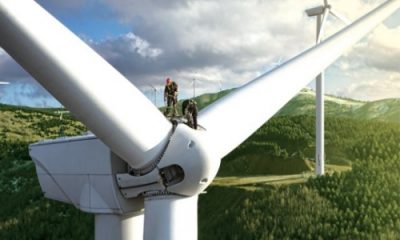
Offshore Wind Energy
World’s most powerful direct-drive floating wind turbine unveiled in China


China has achieved a major breakthrough in clean energy technology with the rollout of the world’s most powerful direct-drive floating wind turbine.
Jointly developed by state-owned enterprises China Huaneng Group and Dongfang Electric Corporation, the 17-megawatt turbine officially rolled off the production line on Thursday in Fujian Province’s coastal city of Fuqing, China Huaneng Group confirmed to Xinhua on Saturday. A single unit can generate 68 million kilowatt-hours of clean electricity annually, enough to power approximately 40,000 households.
The turbine will undergo real-world testing in the waters off Yangjiang, in south China’s Guangdong Province, according to China Huaneng Group. Boasting an operational availability rate exceeding 99 percent, the giant machine features a record-breaking 262 meter rotor diameter with a swept area of approximately 53,000 square meters, equivalent to 7.5 standard soccer fields. Towering 152 meters, its hub is almost as high as a 50-story residential building.
The turbine can withstand extreme maritime conditions, including waves over 24 meters and typhoons at level 17. Its unique stabilization technology enables continuous power generation even when the floating platform tilts at extreme angles.
Liu Xin, director of the offshore wind division at China Huaneng Clean Energy Research Institute, highlighted the turbine’s adaptability, noting that its integrated intel- ligent sensing system enables holistic stability control for safe and efficient operation in complex deep-sea environments.
The project’s research and development team made technological breakthroughs in floating wind power system coupling simulation technology and high-fidelity model testing techniques.
Notably, all its core components, including blades, generators and transformers, are domestically produced, with China’s first large-diameter main shaft bearing incorporated into the design.
This technological breakthrough opens the door to harnessing China’s vast deep-sea wind resources. According to the energy research institute under the National Development and Reform Commission, while nearshore waters (5-50 meters deep) offer around 500 GW of technically developable wind capacity, deep-sea resources are estimated to be three to four times this volume.
Data from the Global Wind Energy Council (GWEC) underscores the global significance, showing that over 80 percent of offshore wind resources are located in waters deeper than 60 meters.
Floating wind power generation technology and solutions are set to further unlock the potential of deep-water wind energy, according to GWEC.
By the end of 2024, the global installed capacity of floating wind power is expected to reach 278 megawatts, with Norway, the United Kingdom, China and France leading as the top four markets, GWEC said.


What’s in this news?
The European Commission has approved a €5 billion Danish State aid scheme to support offshore wind development. Covering the Hesselø and North Sea I Mid projects, the scheme is expected to play a key role in achieving the EU’s 2030 renewable energy targets and accelerating the transition to a net-zero economy.
The European Commission has approved a €5 billion (DKK 37.6 billion) Danish State aid scheme aimed at supporting offshore wind energy deployment.
The measure aligns with the objectives of the Clean Industrial Deal and is designed to contribute to the EU’s 2030 renewable energy targets.
Two offshore wind projects to be supported
The scheme will support the development of two major offshore wind farms:
- Hesselø Offshore Wind Farm
- Minimum capacity: 0.8 GW
- Expected annual generation: ~3.2 TWh
- North Sea I Mid Offshore Wind Farm
- Minimum capacity: 1 GW
- Expected annual generation: ~4.6 TWh
Combined, these projects are expected to generate electricity equivalent to approximately 25% of Denmark’s annual electricity production.

Two-way CfD mechanism
The support will be granted through a two-way Contract for Difference (CfD) mechanism:
- Producers receive payments when market prices fall below the strike price
- Producers pay back when market prices exceed the strike price
This design ensures both investor certainty and proper market functioning.
20-year support period
The scheme will run for 20 years and will be allocated via a competitive bidding process. Support will be based on potential generation capacity rather than actual production.
Supporting EU energy transition
The Commission concluded that the scheme is:
- Necessary and proportionate
- Supportive of the net-zero transition
- Effective in reducing fossil fuel dependency
and compliant with EU State aid rules.

Is Türkiye Ready for Offshore Wind? Industry Perspectives Point to Industrial Potential
Offshore wind energy is becoming one of the fastest-growing segments of the global energy transition. As the sector expands across Europe, discussions around Türkiye’s offshore wind potential are also gaining momentum.
Industry representatives speaking during KEY – The Energy Transition Expo 2026 highlighted both the opportunities and the structural challenges facing offshore wind development in Türkiye.
According to DÜRED Chairman Murat Durak, Türkiye already has a significant industrial base that could support offshore wind projects.
A Strong Industrial Ecosystem
Durak pointed out that Turkish shipyards and heavy industry facilities are already capable of manufacturing various offshore structures and components.
Some shipyards are already involved in manufacturing for European offshore projects, indicating that Türkiye could potentially play a role within the broader offshore wind supply chain.
This industrial capacity suggests that Türkiye could position itself not only as a project developer but also as a manufacturing and supply hub for offshore wind equipment.
Port Infrastructure Remains a Critical Requirement
Despite this industrial capacity, Durak noted that one of the key missing elements is dedicated offshore wind port infrastructure.
Offshore wind projects require large-scale logistics operations for transporting turbine components, installing foundations, and maintaining offshore structures.
Developing suitable port infrastructure is therefore considered an important step for enabling large-scale offshore wind projects in Türkiye.
Supply Chain Opportunities
DÜRED Board Member Bilgihan Yaşacan emphasized the importance of the offshore wind supply chain.
According to Yaşacan, offshore wind development creates opportunities across a wide range of sectors, including:
- marine construction
- engineering services
- offshore platforms
- subsea cable installation
- heavy logistics and equipment manufacturing
He stressed that supporting the development of companies capable of operating in offshore environments will be essential for building a sustainable offshore wind ecosystem.
Regional Opportunities
Industry representatives also highlighted that offshore wind opportunities should not be viewed solely within Türkiye’s domestic market.
Potential offshore wind developments in the Mediterranean region and the Middle East could create additional opportunities for Turkish shipyards, engineering firms, and industrial suppliers.
The Mediterranean Could Become a New Offshore Market
While Northern European countries have led offshore wind development for many years, the Mediterranean region is still considered an emerging market.
According to sector representatives, this situation could create new opportunities for countries with strong industrial capabilities such as Türkiye.
If offshore wind projects begin to expand in the Mediterranean basin, Türkiye’s industrial sector could play an important role in supporting regional offshore wind development.

On 14 January 2026, the United Kingdom awarded a total of 8.4 GW of offshore wind capacity under Allocation Round 7 (AR7), marking the largest offshore wind auction ever held in Europe.
The awarded capacity includes 8.2 GW of bottom-fixed offshore wind and nearly 200 MW of floating wind projects. The new capacity is expected to generate enough electricity to power approximately 10 million homes.
Record competition drives competitive pricing
AR7 was one of the most competitive offshore auctions ever held in Europe. A record 19 projects, representing a combined potential capacity of 24 GW, were eligible to bid.
The strong competition resulted in 2024 strike prices of:
£91.20/MWh in England and Wales
£89.49/MWh in Scotland
These levels are approximately 40% lower than the cost of building and operating new gas plants in the UK (£147/MWh) and nearly 30% lower than new nuclear plants (£124/MWh).
The 8.4 GW of new offshore wind capacity is estimated to save UK billpayers nearly £1.7 billion per year compared to gas generation.
CfD framework proves effective
The UK’s two-sided Contracts for Difference (CfD) mechanism once again demonstrated its ability to de-risk projects and provide long-term revenue visibility.
With a total budget of £1.79 billion — exceeding the initial £1.1 billion allocation — the UK Government secured additional capacity to enhance energy security and economic resilience.
Following the failed AR5 round in 2023 and limited new capacity under AR6, AR7 represents a significant turning point for offshore wind deployment in the UK.
AR7 winning projects
AR7 awarded support to six bottom-fixed offshore wind projects and two floating wind projects:
| Project | CfD Capacity (MW) | Owner(s) | Strike Price (2024) | Delivery (Phase 1) |
|---|---|---|---|---|
| Awel y Mor | 775 | RWE (60%), Stadtwerke München (30%), Siemens Financial Services (10%) | £91.2/MWh | 2030/31 |
| Dogger Bank South | 3000 | RWE (51%), Masdar (49%) | £91.2/MWh | 2030/31 |
| Norfolk Vanguard East | 1545 | RWE | £91.2/MWh | 2029/30 |
| Norfolk Vanguard West | 1545 | RWE | £91.2/MWh | 2028/29 |
| Berwick Bank | 1380 | SSE Renewables | £89.49/MWh | 2030/31 |
| Pentland (floating) | 92.5 | Copenhagen Infrastructure Partners (80%), Eurus Energy (10%), Hexicon (10%) | £216.49/MWh | 2029/30 |
| Erebus (floating) | 100 | TotalEnergies (80%), Simply Blue Energy (20%) | £216.49/MWh | 2029/30 |
The 192 MW awarded to floating wind projects marks another step toward commercial-scale floating wind deployment. Industry stakeholders emphasise the need for tailored support schemes, clear auction timelines for floating wind, and infrastructure investment in ports to sustain momentum.


 Events8 years ago
Canada and Turkey women working in the renewable energy sector in met
- Turbine Technologies8 years ago
GE’s Haliade-X 12 MW prototype to be installed in Rotterdam
- Operations and Maintenance8 years ago
GENBA is on the rise; another milestone passed by in global existence
- Genel11 years ago
EWT launches the DW61, It’s most efficient and high energy producing wind turbine
- Genel11 years ago
Internet of things will empower the wind energy power plants
- Turbine Technologies8 years ago
İğrek Makina focused on developing and producing Machine Tools and Wind Energy Turbines
- Legal & Financial Solutions8 years ago
Demand/Supply – Renewable energy with guarantees of origin (GO)
- Events8 years ago
Key Players from 10 Nations will Show Their Strong Positions at APWEE
- Turbine Technologies6 years ago
ENERCON installs E-160 EP5 prototype
- Turbine Technologies7 years ago
The Nordex Group receives first order for Delta4000 turbines from the USA
- Turbine Technologies8 years ago
ENERCON and Lagerwey together develop two new WEC types
- Genel10 years ago
Zorlu energy envisages a bold new future based on renewables