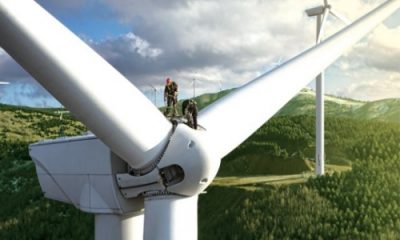
Offshore Wind Energy
Strong 2023 offshore wind growth as industry sets course for record-breaking decade


Offshore wind is poised for truly global growth after 2023 saw the second-highest annual installations as well as key policy developments that set the foundations for accelerated expansion of the industry over the next decade.
In 2023, despite the macroeconomic challenges faced by the sector in some key markets, the wind industry installed 10.8 GW of new offshore wind capacity, taking the global total to 75.2 GW. New capacity increased 24% on the previous year, a growth rate the Global Wind Energy Council expects to see continue up to 2030, if the present increase in policy momentum continues.
In the next ten years, GWEC forecasts that 410 GW of new offshore wind capacity will be installed, bringing offshore wind deployment in line with global targets to install 380 GW by 2030. The majority of that will come at the turn of the decade, with two-thirds installed between 2029 and 2033. This rapid expansion of deployment must be built on a growing collaboration between industry and government and the creation of streamlined and effective policy and regulatory frameworks.
This anticipated growth will be driven by the arrival of the next wave of offshore wind markets like Australia, Japan, South Korea, the Philippines, Vietnam, Brazil, Colombia , Ireland and Poland – where policy developments and unprecedented focus across governments, industry and civil society is setting the conditions for long-term offshore wind development at scale.
The report outlines a “Global Growth Framework for Offshore Wind” for industry and governments planning to rapidly scale up development covering finance, demand and industrial offtake, supply chain development, permitting, social consensus, workforce development and grid infrastructure. GWEC’s position is that forecasted growth is at risk if this framework is not implemented.
Ben Backwell, CEO, Global Wind Energy Council, said:
“Installing almost 11 GW of offshore wind is the leading edge of a new wave of offshore wind growth. Policy progress – especially across the Asia-Pacific region and the Americas – has set us on course to regularly install record-breaking capacity annually, and pass the 380 GW target set up by the Global Offshore Wind Alliance. That means offshore wind is on course to achieve the tripling ambition set at COP28 in Dubai.
“Offshore wind is now so much more than a European, Chinese or American story. In the last year GWEC has seen rapid progress in new markets where the key drivers for offshore wind are now in place – from government commitments to sustainable economic growth, to increased consumer demand and industrial decarbonisation.
Rebecca Williams, Chief Strategy Officer – Offshore Wind, GWEC, said:
“Governments around the world are choosing offshore wind for their people and their economies. We have reached the point in mature markets where the technology is now proven to have the ability to save households money versus conventional energy sources.
“This new wave of offshore wind markets are taking notice and making progress of their own, in some cases outgrowing the ‘emerging’ label thanks to strong collaboration between industry and policymakers. It is vital to continue that cooperation, particularly in this year of significant elections around the world, to ensure targets become turbines and more markets develop in the wake of this decade’s expansion.”
Steven B. Hedlund, President and Chief Executive Officer, Lincoln Electric, said:
“We are very pleased to be a key sponsor for this year’s global offshore wind report, which highlights several key actions needed for further supply chain investment to increase the installed capacity of wind. The future ambitions of the offshore wind industry depends on an expanding supply chain where advanced technology and automation are going to help drive further expansion. Lincoln Electric is committed to play our part and will continue to invest in advanced technology solutions to help the industry grow.”
José Oriol Hoyos, Chairman and CEO of Iberdrola Renewables International, said
“Iberdrola is proud to once again sponsor GWEC’s Global Offshore Wind Report and show our continued deep commitment to this technology. This year is a major milestone and memorable moment in our journey towards a cleaner and sustainable future in which offshore plays a leading role. I encourage the whole industry to apply the same courage demonstrated to overcoming challenges in the past so next year we can proudly say that another record has been set and we are a step closer to meeting our ambitions.”
Qiying Zhang, President and CTO of Mingyang Smart Energy, said
” The utilisation of marine energy, especially offshore wind power, plays a vital role to achieve the global energy transition whilst combating climate change and its impacts. As the world’s leading offshore wind turbine manufacturer and marine energy solutions provider, Mingyang Smart Energy is deeply committed to support the dual objective. We believe that through technological innovation, industrialization and global cooperation our industry can further reduce the cost of energy and ultimately help achieve large-scale offshore wind power deployment. We are proud to support this year


What’s in this news?
The European Commission has approved a €5 billion Danish State aid scheme to support offshore wind development. Covering the Hesselø and North Sea I Mid projects, the scheme is expected to play a key role in achieving the EU’s 2030 renewable energy targets and accelerating the transition to a net-zero economy.
The European Commission has approved a €5 billion (DKK 37.6 billion) Danish State aid scheme aimed at supporting offshore wind energy deployment.
The measure aligns with the objectives of the Clean Industrial Deal and is designed to contribute to the EU’s 2030 renewable energy targets.
Two offshore wind projects to be supported
The scheme will support the development of two major offshore wind farms:
- Hesselø Offshore Wind Farm
- Minimum capacity: 0.8 GW
- Expected annual generation: ~3.2 TWh
- North Sea I Mid Offshore Wind Farm
- Minimum capacity: 1 GW
- Expected annual generation: ~4.6 TWh
Combined, these projects are expected to generate electricity equivalent to approximately 25% of Denmark’s annual electricity production.

Two-way CfD mechanism
The support will be granted through a two-way Contract for Difference (CfD) mechanism:
- Producers receive payments when market prices fall below the strike price
- Producers pay back when market prices exceed the strike price
This design ensures both investor certainty and proper market functioning.
20-year support period
The scheme will run for 20 years and will be allocated via a competitive bidding process. Support will be based on potential generation capacity rather than actual production.
Supporting EU energy transition
The Commission concluded that the scheme is:
- Necessary and proportionate
- Supportive of the net-zero transition
- Effective in reducing fossil fuel dependency
and compliant with EU State aid rules.

Is Türkiye Ready for Offshore Wind? Industry Perspectives Point to Industrial Potential
Offshore wind energy is becoming one of the fastest-growing segments of the global energy transition. As the sector expands across Europe, discussions around Türkiye’s offshore wind potential are also gaining momentum.
Industry representatives speaking during KEY – The Energy Transition Expo 2026 highlighted both the opportunities and the structural challenges facing offshore wind development in Türkiye.
According to DÜRED Chairman Murat Durak, Türkiye already has a significant industrial base that could support offshore wind projects.
A Strong Industrial Ecosystem
Durak pointed out that Turkish shipyards and heavy industry facilities are already capable of manufacturing various offshore structures and components.
Some shipyards are already involved in manufacturing for European offshore projects, indicating that Türkiye could potentially play a role within the broader offshore wind supply chain.
This industrial capacity suggests that Türkiye could position itself not only as a project developer but also as a manufacturing and supply hub for offshore wind equipment.
Port Infrastructure Remains a Critical Requirement
Despite this industrial capacity, Durak noted that one of the key missing elements is dedicated offshore wind port infrastructure.
Offshore wind projects require large-scale logistics operations for transporting turbine components, installing foundations, and maintaining offshore structures.
Developing suitable port infrastructure is therefore considered an important step for enabling large-scale offshore wind projects in Türkiye.
Supply Chain Opportunities
DÜRED Board Member Bilgihan Yaşacan emphasized the importance of the offshore wind supply chain.
According to Yaşacan, offshore wind development creates opportunities across a wide range of sectors, including:
- marine construction
- engineering services
- offshore platforms
- subsea cable installation
- heavy logistics and equipment manufacturing
He stressed that supporting the development of companies capable of operating in offshore environments will be essential for building a sustainable offshore wind ecosystem.
Regional Opportunities
Industry representatives also highlighted that offshore wind opportunities should not be viewed solely within Türkiye’s domestic market.
Potential offshore wind developments in the Mediterranean region and the Middle East could create additional opportunities for Turkish shipyards, engineering firms, and industrial suppliers.
The Mediterranean Could Become a New Offshore Market
While Northern European countries have led offshore wind development for many years, the Mediterranean region is still considered an emerging market.
According to sector representatives, this situation could create new opportunities for countries with strong industrial capabilities such as Türkiye.
If offshore wind projects begin to expand in the Mediterranean basin, Türkiye’s industrial sector could play an important role in supporting regional offshore wind development.

On 14 January 2026, the United Kingdom awarded a total of 8.4 GW of offshore wind capacity under Allocation Round 7 (AR7), marking the largest offshore wind auction ever held in Europe.
The awarded capacity includes 8.2 GW of bottom-fixed offshore wind and nearly 200 MW of floating wind projects. The new capacity is expected to generate enough electricity to power approximately 10 million homes.
Record competition drives competitive pricing
AR7 was one of the most competitive offshore auctions ever held in Europe. A record 19 projects, representing a combined potential capacity of 24 GW, were eligible to bid.
The strong competition resulted in 2024 strike prices of:
£91.20/MWh in England and Wales
£89.49/MWh in Scotland
These levels are approximately 40% lower than the cost of building and operating new gas plants in the UK (£147/MWh) and nearly 30% lower than new nuclear plants (£124/MWh).
The 8.4 GW of new offshore wind capacity is estimated to save UK billpayers nearly £1.7 billion per year compared to gas generation.
CfD framework proves effective
The UK’s two-sided Contracts for Difference (CfD) mechanism once again demonstrated its ability to de-risk projects and provide long-term revenue visibility.
With a total budget of £1.79 billion — exceeding the initial £1.1 billion allocation — the UK Government secured additional capacity to enhance energy security and economic resilience.
Following the failed AR5 round in 2023 and limited new capacity under AR6, AR7 represents a significant turning point for offshore wind deployment in the UK.
AR7 winning projects
AR7 awarded support to six bottom-fixed offshore wind projects and two floating wind projects:
| Project | CfD Capacity (MW) | Owner(s) | Strike Price (2024) | Delivery (Phase 1) |
|---|---|---|---|---|
| Awel y Mor | 775 | RWE (60%), Stadtwerke München (30%), Siemens Financial Services (10%) | £91.2/MWh | 2030/31 |
| Dogger Bank South | 3000 | RWE (51%), Masdar (49%) | £91.2/MWh | 2030/31 |
| Norfolk Vanguard East | 1545 | RWE | £91.2/MWh | 2029/30 |
| Norfolk Vanguard West | 1545 | RWE | £91.2/MWh | 2028/29 |
| Berwick Bank | 1380 | SSE Renewables | £89.49/MWh | 2030/31 |
| Pentland (floating) | 92.5 | Copenhagen Infrastructure Partners (80%), Eurus Energy (10%), Hexicon (10%) | £216.49/MWh | 2029/30 |
| Erebus (floating) | 100 | TotalEnergies (80%), Simply Blue Energy (20%) | £216.49/MWh | 2029/30 |
The 192 MW awarded to floating wind projects marks another step toward commercial-scale floating wind deployment. Industry stakeholders emphasise the need for tailored support schemes, clear auction timelines for floating wind, and infrastructure investment in ports to sustain momentum.


 Events8 years ago
Canada and Turkey women working in the renewable energy sector in met
- Turbine Technologies7 years ago
GE’s Haliade-X 12 MW prototype to be installed in Rotterdam
- Operations and Maintenance8 years ago
GENBA is on the rise; another milestone passed by in global existence
- Genel11 years ago
EWT launches the DW61, It’s most efficient and high energy producing wind turbine
- Genel11 years ago
Internet of things will empower the wind energy power plants
- Turbine Technologies8 years ago
İğrek Makina focused on developing and producing Machine Tools and Wind Energy Turbines
- Legal & Financial Solutions8 years ago
Demand/Supply – Renewable energy with guarantees of origin (GO)
- Events7 years ago
Key Players from 10 Nations will Show Their Strong Positions at APWEE
- Turbine Technologies6 years ago
ENERCON installs E-160 EP5 prototype
- Turbine Technologies7 years ago
The Nordex Group receives first order for Delta4000 turbines from the USA
- Turbine Technologies8 years ago
ENERCON and Lagerwey together develop two new WEC types
- Genel10 years ago
Zorlu energy envisages a bold new future based on renewables